I might have a bit too active of an imagination. At age 8 me and my friends convinced each other through some kind of cult-like behaviour, imagination and the act of play that gnomes existed and were hiding in crevices and holes in our school yard. We ran around hunting them for hours, having a lot of fun and scary ventures into basement systems and abandoned government buildings.
These days we laugh about our gnome hunting adventures and are all perfectly capable of knowing the truth: that we were just kids playing and gnomes were never real.
The act of believing really really hard kinda made it all feel very real though. GNOMES DID EXIST albeit only for a brief moment. And I have hungered for that magical feeling ever since. Three years ago I think I finally understood the trick and I have consciously been doing that with my ttrpg world ever since, and girl ✨ that shit rocks. OUR GAME: IT'S REAL.
Since 2022 I have been running most of my tabletop games in a setting I have nicknamed GREEN FLAME. For the last year or so I have also been using a custom game system [1] to run the game in. OSR inspired stuff. [2]
The setting is older than 2022 however, as I have been kind of patch-working as many of my old games, their worlds and characters into Green Flame as possible. It has resulted in a rather fleshed out world with distinct areas and cultures, history and secrets. Full of characters of note. Two such characters are Bombalin Blækflaske and Serrenitus Blackstaff, they have had an immense impact on how I view the overall continuity of the world and in a sense I have kind of been taught it by them. I'll talk more about those guys in another post eventually.
Immersion is really important to games. It is after all called a role playing game and when you take on a role and attempt to put yourself in the shoes of another not-real(?) person, every distraction and lack of the quality we call immersion can not only just make your experience around the table with your friends worse, but also (and in my opinion this is even more catastrophic) you can end up making choices that does not align with what your character would do! A VISCOUS CYCLE OF NON-IMMERSION.
I'd go as far and say that the games I enjoy playing the most shouldn't even really be called role playing games. But more like, simulation role playing games. Or something like that.
There's a reason there's a "horse trait" table in the ADND Dungeon Masters Guide (pg. 55 table 26)
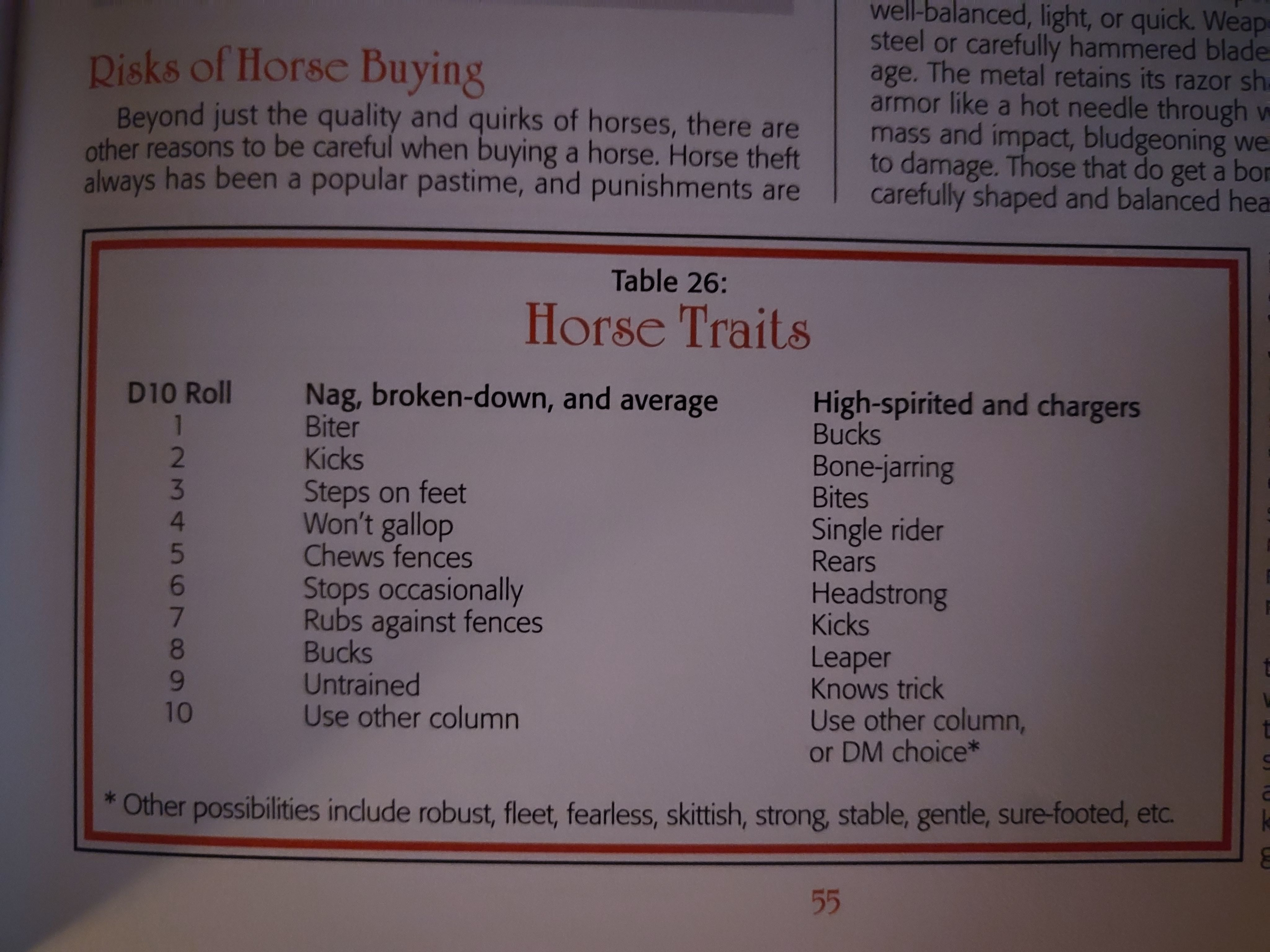
This is not just about immersion: yes from an immersion perspective it is awesome to know that Regdar the Fighters horse Jeff chews on fences, but I would say these kind of tables (which are littered all throughout the early dnd books) have only the intention of simulating a world. They are not obsessed with rulings or mechanics. Nowhere does it say how often Jeff chews on fences or if it provides some sort of penalty mechanically. These books are trying to describe how to translate a simulation of a realistic world into a format that can be expressed in human dialogue and attempts to teach the readers of the books what is important to highlight during play, in order to create a convincing simulation.
When adding the random percentile chances of a horse you come upon being given one of these features, it feels even more simulationist. No one really chose that specific horses characters traits. It was random that Jeff chews on fences. It FEELS unique. Of course there is underlying math of the table and the possibilities put upon it makes it so SOMEONE came up with possibilities, but neither GM or Player knew how the horse was gonna turn out when Regdar ran into the tavern stable and dragged out the nearest horse to pursue villains.
These kind of coincidences sets the game on a path that is eerily familiar to those of us that inhabit Earth in reality. We never really know exactly what will happen around the next corner, none of our consciousnesses, not the voice that you speak with in your head, nor the silent gravely voice that warns you of danger, or the pitchy anxious voice knows. You just live and via happenstance your life-story unfolds, beautiful and tragic.
When we start using Random Tables in the right way. We invite in the possibility of unforeseen beauty.
I have (in my opinion) a great example of this from a session a year or so back. These are pieces of that play report [3] for that session.
On their journey through the forest (now nicknamed Old Wood) our group of intrepid explorers came upon a burial mound. Despite other adventurers having passed through this region before, none had noticed the entrance until now. Tefarius The Breggle wagers it is due to the thick tree roots covering the forest floors, he urges his comrades in arms and exploration to from now on carefully examine areas that are known to have been inhabited by the Verul Horde.
As they entered the last and so far largest chamber, Melleleleje immediately became aware that they had sprung a trap that had laid dormant for eons. A thin long white strand of hair had broken as she had breached the entrance and piles of bones animated, clanging and shaking. Skeleton warriors assembled to guard their masters tomb.
However, the brief glimpse into the room they had gotten revealed to the adventurers a large wooden chest, several clay pots and a stone sarcophagus.
They were sure that this was the resting place of the Necromancer that had enchanted and created this burial mound full of nasty curses. Maybe it'd reveal the key to the magic that guarded this dangerous place!
after some battling and Mels shield being broken...
A rusty sword cut into the side of Mels armor, cracking mail and bone, enormously heavy hits fueled by necromantic magic. She knew they had to retreat and shouted for her companions to run back towards the surface. She attempted to block the narrow hallway, a cunning tactic in most other scenarios -small corridors would make it so only one creature could reach her at a time- however, the skeletons bones simply moved forward, floating into each others space, a non-form, the idea of humanoid structure simply an illusion and immediately ribcages, skulls and swords proceeded to batter The Elf. She fell. Dying.
At this point, I -The Dungeon Master- in my Green Flame system roll a 1d4+(character level). This determines how many turns the character who is dying has left until they are dead. They can be saved by magical healing while in the dying condition, none of which was accessible to the remaining 2 players at the table. They got really desperate.
Melleleleje (the elf warrior) that got knocked to 0 hitpoints was a mainstay character in the campaign, one of the highest level people and much beloved by the player that played her, as well as everyone else at the table. Everyone immediately became tense, realizing the seriousness of the situation, and they wanted to try to figure out something - anything to do.
I can't remember (or don't have it noted anywhere) what Mels character level was at the time. But I rolled a total of 4 rounds remaining until she died.
I as the GM was also nervous. Nevertheless, I had created a dungeon room that contained monsters, and I could not cheat the dice or in any other way influence the current outcome. Skeletons have simple logic, they attack and as I roll in the open in combat scenarios and as with most roleplaying games of the dnd kind there are solid procedures for how to handle combat, I (even if I wanted to) had no means to fudge the dice. I don't wanna cheat death when it does occur. It is important to the flow of the game.
Miraculously the remaining players managed to destroy the skeletons in 1 round as they realized that these types of skeletons were weak to fire. Mel had also damaged them something fierce already. The skeletons fell.
One player started looking through Mels inventory, an experienced adventurer like her might have been carrying secret healing gear (A couple of rounds of searching revealed none of such magic on Mels person).
The other player used their round to run into the main burial chamber and immediately went for the chest and opened it. Lucky for them it didn't contain any traps.
When I had made the dungeon a few months prior I had noted the type of treasure the chest contained and I checked my notes.
It was an M4 Hoard from the Dolmenwood Campaign Book. I hadn't actually rolled it yet though and this meant (with my interpretation of the rules) that there would be:
I can't remember if they got magic items and my notes don't detail the magic items, but what is remembered is that they ended up with a potion.
Then I had to roll what potion it was and I rolled a 1d20 on the potion table and got a 15. A Prismatic Elixir. It heals 1d6+1 hitpoints.
The character grabs it and runs to Mels body. That was 3 turns. The last turn they use to uncork the bottle and shove it into Mels face. Reviving her instantly.
Exactly 4 turns needed for this sequence to happen according to the rules we use in Green Flame, and exactly the right potion all based on chance.
Had everything not happened in this exact order, Mel the Elf would have died that day. She didn't. No swindling of the dice or being loose with the rules allowed it. It all happened as it should.
It was an enormously satisfying moment for everyone at the table. But I tell this story to highlight how randomness, how this sequence of events couldn't have been pulled off in the same satisfactory manner had I not purposefully created a dungeon with strict rules and adhered to the contents I had made even after we were facing the possibility of having to say goodbye to an enormously beloved character.
Had I put a potion into that chest on purpose, maybe redconned it in there as I realized that the players were in trouble, their victory would have been hollow. It would have been less real. I as a god figure* (read game master) would have taken away the beauty of coincidence and made the world less real.
Because... The real world is not forgiving. There is no god watching over us. Everything just panned out in a manner that was beautiful. I deeply believe humans inherently are drawn to beauty in the accidental and random and this just highlighted it for me. The world felt real for a moment.
Another important key to this whole puzzle is to have the world have memory. Keep detailed records of what players have said to different NPCs. Have a calendar [4] and keep track of motivations of factions and power players in the region. If the players defeat a major power that have ruled the land cruelly it WILL effect everyone else in that region when suddenly there's no dictator breathing downs everyones neck. The players reputation will change and with it how people treat them.
An exercise I do when I am going to sleep, riding the train or just generally are in the mood and have nothing better to do is to think about what certain NPCs are doing when the players are not around. Sometimes I consult simple dice rolls to determine outcomes of questions I have and all of this ends up with me having NPCs that goes on journeys, have mercenary troop movements that I write into my calendar so I know when they reach certain places, and so on and so forth.
The world exists every time you think about it.
Every time the spotlight of human consciousness hits the ttrpg world, the inhabitants come to life and can take action. The more time is dedicated to you and your players thinking about it, the more living it is.
So we create this vast hexcrawl with lots of tables full of random chance, full of locations to explore and we attempt our best to make it realistic/believable and through thought we animate it.
Then, as you can probably guess from the last paragraph in the last chapter, we breathe delusion into it.
What really made this make sense for me was through reading the Ed Greenwood and Elminister articles dubbed "The Wizards Three" published in Dragon Magazine. [5]It kind of rewired my brain to be honest. I still struggle to articulate "how" exactly it did that, but I think my best attempt can be found in my story about gnome hunting that I gave you in the very beginning of this blog post. The more we believe, the more real it becomes, the easier it is to relate to even absurd ideas. When we find ways to connect things to our own world suddenly there's a degree of truth.
By the way, Ed Greenwood is still doing this bit regularly, here he is at Gen Condy Indy 2023 taking questions as Elminister. I love it.
Who's to say we are not dreaming up actual living people when we play roleplaying games? Who's to say that you right now reading this is not a character partly puppeteered by a group of happy friends somewhere in another universe and their shared dream is so powerful you experience life?
The more we stick to the story (without becoming insane in the process of course) the easier immersion is, the easier buy-in is and the more real the game becomes.
This is at least true for me. In my setting I have my own wizards of power, that are slowly discovering that they are in fact living in a game.
Bombalin Blækflaske (mentioned earlier) is a character that have attained a high level of power in the arcane school of divination and he have figured out that some people seemingly have more agency in the world than others. Or at least that something seems to be watching them. To us those people are players, but Bombalin isn't really quite sure yet what they are and often seek out these people to sort of "appear" in the story. On some level he have discovered he exists "more" when he is in the story.
Serrenitus Blackstaff, also a wizard, has due to a very powerful artifact that makes him able to roll 1d30's on knowledge checks slowly begun to uncover the mathematical properties of chance related to what we would call character stats and abilities. He can calculate these essentials and are for a lack of more fancy wording trying to understand the logic of what we would call our dice rolls.
I might just be insane, but stuff like this makes me believe more in my world. Leading to a better gameplay experience, but also a seriousness that I think is infectious.
I don't really have a very specific point with this ramble. These are simply thoughts that have kind of guided me in my world building and roleplaying philosophy for a while now and I am not only a better gamemaster than ever, I also am having the most fun I have ever had with the game, which is kind of crazy considering I have been playing ttrpg's since I was 6 years old and are now entering my thirties.
So, I guess this is a toast to sharing fever dreams with friends. Making make belief stories of love and triumph and evil and how it is defeated. And how pretending to believe in gnomes with your best bud makes the world a little more magical.
[1]
Green Flame is a mishmash system of various sources of inspiration, hugely OSR in philosophy but attempting to make it possible for those of my friends that are really into character building through feats and such to still have a lot of fun and finding "optimal" or cool builds. It's a system that combines our favorite childhood memories of 3.5 with newer sleeker game design and the brutal honesty of OSR. I will eventually publish this system. For now it is still being written and "playtested" in my personal groups. A lot of the procedures of how to play it hasn't been put into words yet as I struggle to explain my approach to gamemastering and the text assumes the reader is already aware or can directly ask me - hopefully my website can help me condense my thoughts on the matter so I can write it down! :3[2]
For those of you who don't know what the OSR is, it stands for Old School Roleplaying or maybe it is Old School Renaissance? Revival??? Who knows. There's some debate about that in the community. What is important to know, I suppose, and how I use it is that I equate it to games that use game systems based upon the very first editions of dungeons and dragons BUT more importantly use the PROCEDURES OF PLAY of those early games. See Primastic Wasteland and Lithyscape for more explanations of the OSR.https://www.prismaticwasteland.com/blog/the-universal-procedure-of-the-osr https://lithyscaphe.blogspot.com/p/principia-apocrypha.html
[3]
In the Green Flame campaign play reports are in-world newsletters published in the main city the campaigns adventurers belong to. The paper is called "Frontier News". Players receive pay for sharing their findings and information with Frontier News and if they publish an article in the paper.[4]
Gary was really really right when he said all that about time keeping.https://grognardia.blogspot.com/2009/07/time-in-old-school-campaign.html
[5]
The Wizards Three appeared in dragon magazine (a hugely influential dungeons and dragons magazine) between 1992 and 2007. Ed Greenwood who is the creator of The Forgotten Realms setting imagined the most powerful wizards of his setting having a meeting in his own home on Earth and it is just kinda fascinating. It brings the world of Oerth and Earth into a shared space. Even though we all know it is just a little bit of a funny bit. It to me still hugely inspired how I have chosen to think about "made-up worlds".The very first article in Dragon Magazine #185 appears on page 57 titled "Magic in the Evening" and can be read here. You should really consider reading it if you are up for taking sanity damage.
https://dn721605.ca.archive.org/0/items/DragonMagazine260_201801/DragonMagazine185.pdf